
High-Purity Industrial & Food-Grade Papain Enzyme (6,000 USP U/mg / 100 TU/mg)
Purified cysteine endopeptidase extracted from premium non-GMO Carica papaya latex. Engineered for rapid peptide bond cleavage, protein solubility improvement, beer colloidal chill-proofing, and controlled meat tenderization with zero off-flavor generation.
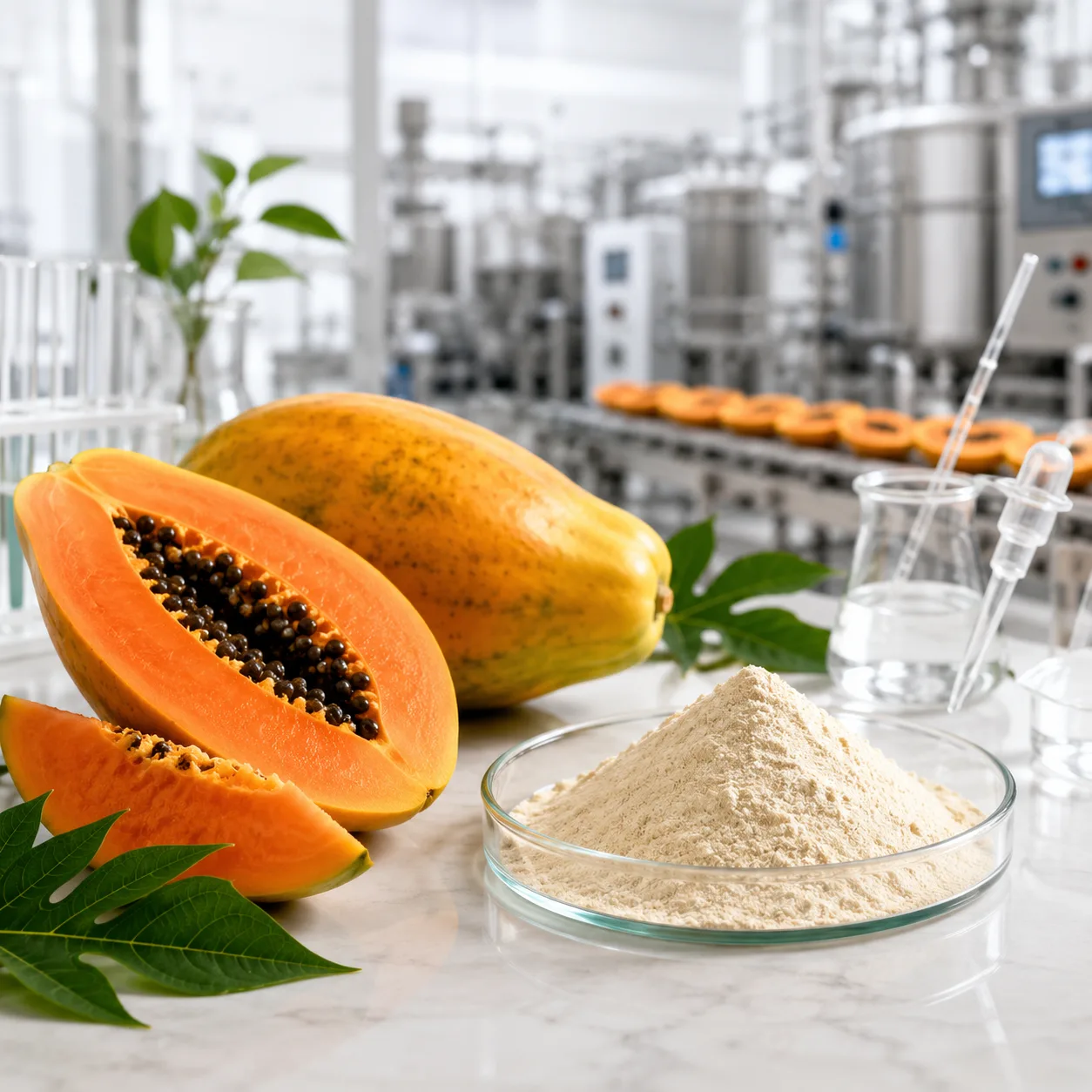
Cysteine Endopeptidase Catalytic Mechanism
Antozyme Papain contains a catalytic triad of Cys25, His159, and Asn175. The active nucleophilic thiol (-SH) group cleaves internal peptide bonds specifically adjacent to basic amino acids (arginine, lysine) and bulky hydrophobic residues (phenylalanine, tyrosine, leucine). Unlike non-specific chemical hydrolysis, our controlled enzymatic cleavage produces predictable molecular-weight peptides and free amino nitrogen (FAN) without bitterness.
Cleavage Mode & Substrate Target
Endo-acting thiol-dependent peptide hydrolase
Turnover Rate & Specific Velocity
Engineered for rapid catalytic saturation, maintaining high turnover velocity at low inclusion rates. This reduces batch cycle time by up to 40% across commercial bioreactors.
Zero Harmful Side-Reactions
Purified via precision ultrafiltration to remove undesirable secondary enzymatic activities, preventing bitter peptides, haze artifacts, or textile fiber degradation.
Technical Specifications & Analytical Parameters
Antozyme manufactures Papain Enzyme in both spray-dried micro-granule powder and stabilized liquid concentrate formats.
| Analytical Parameter | Certified Specification Standard | Compliance Monograph |
|---|---|---|
| Systematic Name | Cysteine endopeptidase | Verified PASS |
| EC Number | EC 3.4.22.2 | Verified PASS |
| CAS Registry Number | 9001-73-4 | Verified PASS |
| Source Botanical | Latex of Carica papaya L. (Non-GMO) | Verified PASS |
| Declared Activity | 6,000 USP U/mg (Standardized 100 TU/mg, custom up to 2M USP/g) | Verified PASS |
| Optimum Temperature | 55°C – 75°C (Active 45°C – 80°C) | Verified PASS |
| Optimum Operating pH | 6.0 – 7.5 (Tolerant 5.0 – 9.0) | Verified PASS |
| Physical Form | Off-white to light cream free-flowing micro-powder | Verified PASS |
| Standardization Carrier | Food-grade maltodextrin / lactose / NaCl | Verified PASS |
| Loss on Drying | ≤ 6.0% (Karl Fischer) | Verified PASS |
| Heavy Metals (as Pb) | ≤ 10 ppm (Complies with FCC/USP) | Verified PASS |
| Arsenic (As) | ≤ 2 ppm | Verified PASS |
| Total Plate Count | ≤ 10,000 CFU/g | Verified PASS |
| Salmonella & E. coli | Negative in 25g | Verified PASS |
| Standard Packaging | 25 kg fibre drums with food-grade double PE liners | Verified PASS |
| Shelf Life & Storage | 24 months sealed at 4°C – 25°C in dry conditions | Verified PASS |
Primary Industrial Application Areas & Dosing Guidelines
Select an industrial sector to inspect operating parameters, typical inclusion rates, and verified processing yield gains.
Uniform Muscle Fibre Cleavage & Tenderness
Hydrolyzes actomyosin and collagen crosslinks in beef, mutton, and poultry cuts without turning meat mushy. Penetrates deep muscle tissues rapidly during dry-rub seasoning or automated needle injection tumbling.
Enzyme Kinetics, Temperature Window & Stability
Industrial bioprocesses require precise catalytic control under varying plant conditions. Antozyme Papain Enzyme is formulated for consistent reaction kinetics across wide thermal and pH gradients.
Thermodynamic Activity Profile (45°C – 80°C)
Papain exhibits exceptional thermal stability for a plant enzyme, with peak catalytic velocity between 60°C and 70°C. In industrial applications, this allows rapid hydrolysis during the initial heating phase of cooking or mash-in, followed by complete, irreversible denaturing above 82°C to prevent over-hydrolysis.
Broad pH Tolerance (5.0 – 9.0)
While optimum activity occurs between pH 6.0 and 7.5, Papain retains over 70% of its catalytic capacity across an expansive pH window of 5.0 to 8.5. This versatility enables robust performance in acidic beer wort (pH 4.2–5.2) and alkaline detergent or tannery floats (pH 8.0–9.0).
Thiol Activation & Reductive Protection
Because the active site relies on a free sulfhydryl (-SH) cysteine residue, exposure to heavy metal ions (Cu²⁺, Fe³⁺, Hg²⁺) or excessive aeration can cause reversible oxidation. Standard industrial batches are stabilized with food-grade reducing agents (ascorbic acid, sodium bisulfite, or cysteine) to preserve 100% catalytic potency.
Industrial Raw Material Compatibility & Specific Dosing Matrix
Recommended commercial inclusion rates across primary industrial substrates. Exact dosage varies based on dry solids concentration, retention time, and desired endpoint.
| Substrate Type | Solids % (DS) | Operating Temp | Recommended Dosing | Target Metric | Demonstrated Process Gain |
|---|---|---|---|---|---|
| Beef & Mutton Muscle Cuts | 25% – 30% | 55°C – 65°C | 15 – 25 g / 100 kg meat | Warner-Bratzler shear < 3.5 kg | Eliminates tough chew; 22% tenderness improvement without surface mushiness |
| Brewery Wort / Lagering Beer | 8% – 12% Plato | 0°C – 4°C | 1.5 – 3.0 g / hL beer | Haze < 0.6 EBC units | Guaranteed 180-day chill stability with zero loss of head retention |
| Soy Protein Isolate (SPI) | 10% – 15% | 60°C – 65°C | 0.2% – 0.4% w/w protein | DH 12% – 16% | Increases nitrogen solubility index (NSI) from 45% to 88% with zero bitter peptides |
| Bovine / Fish Collagen Slurry | 12% – 20% | 55°C – 60°C | 0.3% – 0.6% w/w | MW < 3,000 Daltons | High-purity collagen peptide extract with 96% bioavailability |
| Soft Biscuit & Cracker Flour | Dough moisture 28% | 28°C – 32°C | 3 – 6 g / 100 kg flour | Gluten extensibility index 180 | Uniform cookie stack height, zero shrinkage, chemical sulfite replacement |
| Goat / Cow Pelts (Tannery) | Float ratio 1:2 | 36°C – 38°C | 0.3% on pelt weight | Complete scud clearing | Superior grain elasticity, uniform dyeing uptake, 35% COD reduction |
Comparative Benchmark: Antozyme vs. Conventional Alternatives
Head-to-head performance comparison across seven critical commercial and operational parameters.
| Operational Metric | Antozyme Proprietary Formulation | Conventional Product | Chemical Reagent / Alternative |
|---|---|---|---|
| Active Catalytic Site | UltraPure Cysteine (-SH) Protease | Crude Botanical Latex Powder | Microbial Fungal Protease (Aspergillus) |
| Specific Proteolytic Assay | 6,000 USP U/mg (Standardized) | 1,500 – 2,500 USP U/mg (Variable) | 50,000 HUT/g |
| Thermal Operating Ceiling | 75°C (Active up to 80°C) | 65°C max before inactivation | 50°C (Inactivates rapidly >55°C) |
| Off-Flavor & Bitterness | Zero bitter hydrophobic peptides | Mild bitter botanical note | Moderate bitter peptide release |
| Heavy Metal Compliance | < 10 ppm Pb, < 2 ppm As (ICP-MS) | souvent borderline 15–20 ppm | < 10 ppm |
| Solubility in Water | 100% Instant Clear Dissolution | Turbid with botanical sediment | 90% – 95% Soluble |
| Shelf Life Retention | ≥ 92% after 24 mo at 25°C | 75% – 80% with rapid oxidation | 85% after 18 months |
4-Stage Continuous Operating Plant SOP
Plant operating protocol designed for industrial shift supervisors, brewmasters, and chemical plant operators.
Hydration & Stock Solution Pre-Activation
Dissolve weighed Antozyme Papain powder in 10–20x cold potable water (15°C–25°C). Avoid vigorous aeration to prevent sulfhydryl oxidation. If using tap water with residual chlorine > 0.5 ppm, add 50 ppm ascorbic acid.
Substrate Inoculation & Dispersion
Dose enzyme solution into the agitated reaction vessel or marinade brine. Ensure mechanical mixing spreads the enzyme evenly across all protein interfaces prior to thermal ramp.
Controlled Hydrolysis Thermal Hold
Ramp system temperature to target holding zone (55°C–65°C for meat/HVP; 35°C–40°C for leather; 0°C–4°C for bright beer). Maintain calibrated agitation and monitor degree of hydrolysis (DH) via formol titration or viscosity.
Thermal Inactivation & Final Filtration
Once target viscosity collapse or peptide profile is verified, elevate temperature to ≥ 85°C for 10 minutes to irreversibly denature the enzyme. For beer chill-proofing, filtration through kieselguhr/sterile pads retains crystal brilliance.
Specimen Certificate of Analysis (COA)
Lot-specific analytical report demonstrating typical batch release testing and microbial clearance.
| Test Parameter | Analytical Test Method | Standard Release Limit | Actual Lot Result | Verification |
|---|---|---|---|---|
| Papain Proteolytic Activity | USP / FCC Tyrosine Monograph | ≥ 6,000 USP U/mg | 6,420 USP U/mg | PASS |
| Physical Appearance | Visual Inspection | Cream to off-white micro-powder | Conforms | PASS |
| Loss on Drying | Karl Fischer Titration | ≤ 6.0% | 4.18% | PASS |
| Heavy Metals (as Pb) | ICP-MS Spectrometry | ≤ 10 ppm | < 1.8 ppm | PASS |
| Arsenic (As) | ICP-MS Spectrometry | ≤ 2 ppm | < 0.4 ppm | PASS |
| Total Aerobic Microbial Count | BAM / USP <61> | ≤ 10,000 CFU/g | 1,200 CFU/g | PASS |
| Coliforms & E. coli | BAM / ISO 4832 | Negative in 25g | Negative | PASS |
| Salmonella Species | ISO 6579 / BAM | Negative in 25g | Negative | PASS |
Packaging & Loading Configurations
Export packaging is designed to safeguard enzyme potency across international ocean freight lanes.
Double food-grade polyethylene inner heat-sealed liners with tamper-evident locking rings. Net: 25.0 kg | Tare: 1.8 kg.
Heavy-duty UN-rated high-density polyethylene containers with degassing caps to prevent pressure accumulation during sea transit.
Accommodates 800 fibre drums (20 Metric Tons net) palletized and shrink-wrapped with maritime container desiccants.
Global Port Transit Time Matrix
Fast ocean sailings routed from India's premier western ports: Nhava Sheva (JNPT) and Mundra Port.
| Destination Port | Origin Port | Sailing Transit | Service Frequency |
|---|---|---|---|
| Chittagong, Bangladesh | Nhava Sheva / Mundra | 5 – 7 Days | Bi-weekly Direct feeder |
| Jebel Ali, Dubai (UAE) | Mundra Port | 3 – 5 Days | 3 Sailings / Week |
| Ho Chi Minh City, Vietnam | Nhava Sheva | 10 – 14 Days | Weekly mainline service |
| Jakarta / Surabaya, Indonesia | Nhava Sheva | 12 – 15 Days | Weekly direct vessel |
| Mombasa, Kenya (East Africa) | Mundra Port | 10 – 12 Days | Weekly direct route |
| Santos, Brazil (Latin America) | Nhava Sheva | 28 – 35 Days | Fortnightly mainline |
| Rotterdam, Netherlands (Europe) | Mundra / Nhava Sheva | 20 – 24 Days | Weekly express direct |
Complementary Industrial Enzymes
Commonly paired in industrial formulation with Papain Enzyme to maximize biocatalytic efficiency:
Target Industry Solutions Hubs
Explore in-depth engineering guides for specific industrial processing verticals:
Frequently Asked Technical & Commercial Questions
Clear answers regarding Papain Enzyme dosing calibration, kinetics, shelf life, and international export logistics.
Request a Free 100g Lab Sample or Bulk Quote
All inquiries deliver directly to info@antozymebiotech.com and our export desk. Typical response time within 4 business hours.