
High-Concentration Thermostable Alpha-Amylase (100,000+ U/g)
Engineered from high-expression Bacillus licheniformis for rapid, endo-catalytic starch liquefaction and viscosity breakdown at continuous temperatures up to 105°C. Fully compliant with food-grade FCC, pharmaceutical USP, and industrial continuous jet-cooking standards.
Alpha-Amylase UltraTherm™
- Zero retrogradation risk: Rapidly hydrolyzes α-1,4 bonds preventing amylose crystallization in cooling towers.
- Broad industrial compatibility: Verified performance in jet cookers, jigger steamers, and multi-stage mash tuns.
- Dust-free formulation: High-density micro-granulated powder minimizes inhalation risk for plant operators.
High-Temperature Starch Liquefaction & Rapid Viscosity Reduction
Antozyme’s thermostable alpha-amylase is an endo-acting hydrolase that randomly cleaves internal α-(1,4) glucosidic linkages in both gelatinized amylose and amylopectin molecules, breaking high-molecular-weight starch polymers into low-viscosity soluble dextrins and short oligosaccharides.
Ultra-High Thermal Window
Maintains continuous structural stability between 85°C and 105°C. Survives temperature spikes in jet cookers up to 110°C, ensuring rapid liquefaction without enzyme inactivation.
Steep Viscosity Collapse
Reduces slurry viscosity within minutes of addition, eliminating pumping resistance, reducing motor torque load, and accelerating heat exchange efficiency across industrial evaporators.
Predictable DE Evolution
Delivers controlled Dextrose Equivalent (DE) values between 10 and 18 without premature over-saccharification, creating the optimal substrate feed for subsequent glucoamylase or pullulanase reactions.
Key Technical Specifications & Analytical Parameters
Tested and verified in accordance with Food Chemicals Codex (FCC) and international pharmacopoeial methods.
| Specification Parameter | Standard Analytical Value (Powder Form) | Compliance Standard |
|---|---|---|
| Systematic Name | 1,4-α-D-glucan glucanohydrolase | IUBMB / IUPAC Standard |
| EC Number | EC 3.2.1.1 | IUBMB / IUPAC Standard |
| CAS Registry Number | 9000-90-2 | IUBMB / IUPAC Standard |
| Production Strain | Non-GMO Bacillus licheniformis | IUBMB / IUPAC Standard |
| Declared Activity | 100,000 U/g – 140,000 U/g (Customizable) | FCC / JECFA Compliant |
| Optimum Temperature | 85°C – 105°C (Active up to 110°C in jet cookers) | FCC / JECFA Compliant |
| Optimum Operating pH | 5.5 – 6.5 (Operational range 5.0 – 7.5) | FCC / JECFA Compliant |
| Physical Appearance | Free-flowing light brown to beige micro-granule powder | FCC / JECFA Compliant |
| Carrier / Excipient | Food-grade maltodextrin / starch matrix | FCC / JECFA Compliant |
| Calcium (Ca²⁺) Tolerance | Requires 50–70 ppm Ca²⁺ for maximum thermal stability | ISO 9001:2015 QC Lot Verified |
| Loss on Drying | ≤ 8.0% | ISO 9001:2015 QC Lot Verified |
| Heavy Metals (as Pb) | ≤ 10 ppm (Compliant with FCC & FAO/WHO) | ISO 9001:2015 QC Lot Verified |
| Total Plate Count | ≤ 10,000 CFU/g | ISO 9001:2015 QC Lot Verified |
| Salmonella & E. coli | Absent in 25g | ISO 9001:2015 QC Lot Verified |
| Standard Packaging | 25 kg multi-wall kraft paper drums with double PE liners | ISO 9001:2015 QC Lot Verified |
| Shelf Life & Storage | 24 months in sealed original packaging below 25°C | ISO 9001:2015 QC Lot Verified |
Primary Industrial Application Areas & Dosing Guidelines
Trusted across 25+ countries by commercial distilleries, industrial bakeries, wet starch mills, and textile processors.
High-DE Glucose, Maltodextrin & HFCS
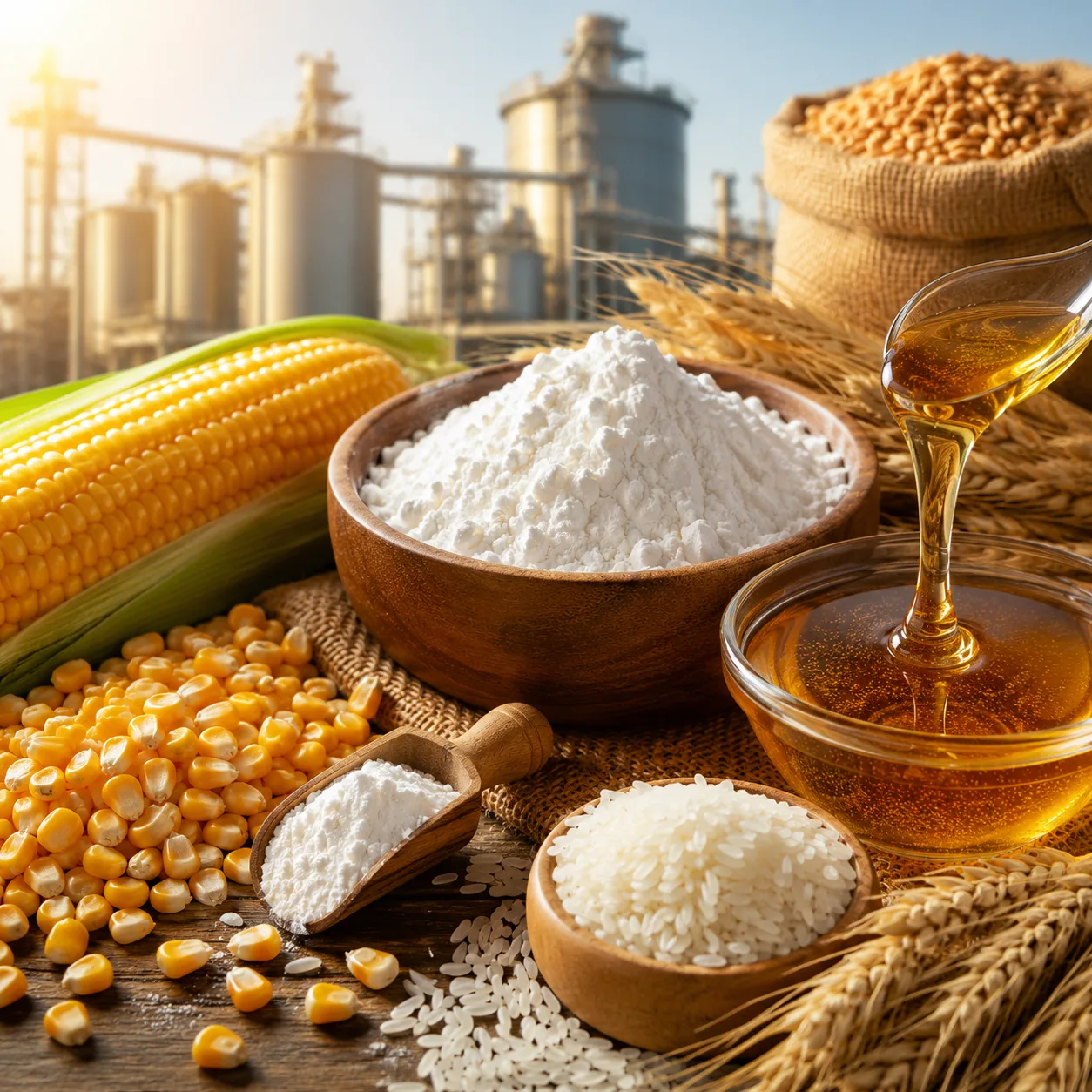
Cleaves interior α-1,4-glucosidic bonds in gelatinized corn, tapioca, and wheat starch slurries, rapidly collapsing viscosity and generating controlled Dextrose Equivalent (DE 10–18) syrups without retrogradation.
Enzyme Kinetics, Temperature Window & Calcium Ion Stabilization
Understanding the catalytic boundaries of Bacillus licheniformis endo-amylase allows plant managers to optimize energy consumption and minimize holding time.
While activity begins at 65°C, maximum cleavage rate occurs at 98°C. In high-pressure jet cookers, the enzyme retains full catalytic function at 105°C for up to 10 minutes without conformational denaturing.
Operating effectively from pH 5.0 to 7.5. Eliminates the necessity for severe chemical acid/alkali adjustments in raw grain mashes and standard wet-milling slurry channels.
Calcium acts as an essential allosteric stabilizer, locking the enzyme’s catalytic cleft against thermal disruption. In softened or reverse-osmosis process water, dosing 0.15–0.25 g CaCl₂/kg dry starch provides complete protection.
Industrial Raw Material Compatibility & Specific Dosing Matrix
Tailored dosage rates across varied plant substrates to ensure rapid liquefaction without retroactive gel formation.
| Substrate / Raw Material | Dry Solids (DS %) | Liquefaction Temp | Dosage Rate | Target DE Value | Process Efficiency Gain |
|---|---|---|---|---|---|
| Corn / Maize Starch | 30% – 35% DS | 105°C – 108°C (Jet) | 0.25 – 0.40 kg / MT | DE 12 – 16 | Eliminates gel crusting in flash chambers; low calcium demand. |
| Broken Rice / Grain Mash | 28% – 32% DS | 98°C – 102°C | 0.30 – 0.50 L / MT | DE 14 – 18 | Maximizes alcohol proof/ton; prevents heat exchanger fouling. |
| Tapioca / Cassava Starch | 28% – 33% DS | 95°C – 100°C | 0.20 – 0.35 kg / MT | DE 10 – 15 | Rapid liquefaction with clear syrup transparency. |
| Wheat Starch & Flour | 26% – 30% DS | 92°C – 98°C | 0.25 – 0.40 kg / MT | DE 12 – 15 | Handles high-viscosity pentosan and gluten glutenin networks. |
| Barley & Raw Grain Grists | High-adjunct mash | 68°C – 85°C | 0.15 – 0.30 kg / MT | Rapid Runoff | Boosts brewhouse extract by 2–4%; accelerates lautering by 25%. |
| Potato Starch Slurry | 25% – 30% DS | 88°C – 95°C | 0.20 – 0.30 kg / MT | DE 10 – 14 | Lowers high native potato starch peak viscosity in seconds. |
Antozyme UltraTherm™ vs. Standard Industrial Alpha-Amylases
A technical performance comparison demonstrating how high-expression bacterial amylase reduces plant OpEx.
| Performance Metric | Antozyme UltraTherm™ (B. licheniformis) | Conventional Bacterial Amylase (B. subtilis) | Fungal Alpha-Amylase (A. oryzae) |
|---|---|---|---|
| Thermostability Range | 85°C – 105°C (Spikes to 110°C) | 75°C – 85°C (Rapid thermal decay) | 50°C – 65°C (Inactivates in boiling) |
| Starch Jet-Cooking Compatibility | ✓ Full Direct Steam Jet Injection | ✗ Inactivated in high-pressure jets | ✗ Incompatible (baking oven only) |
| Viscosity Collapse Speed | < 3 minutes in 32% mash | 10–15 minutes hold required | Slow (not suited for heavy mash) |
| Calcium (Ca²⁺) Dependency | Low (50–70 ppm Ca²⁺ sufficient) | High (150–200 ppm Ca²⁺ mandatory) | Moderate requirement |
| Retrogradation Prevention | ✓ 100% Cleaved into non-gelling dextrins | Moderate risk of starch gel reform | Produces maltose/glucose mainly |
| Standard Activity Density | 100,000 – 140,000 U/g | 20,000 – 40,000 U/g | 5,000 – 15,000 SKB/g |
| Dosage Efficiency / MT Substrate | 0.2 – 0.5 kg / MT (Lowest OpEx) | 1.2 – 2.0 kg / MT | High dosage required in mash |
Continuous Jet-Cooking Liquefaction Protocol (SOP)
Recommended dosing protocol for continuous starch processing plants, ethanol distilleries, and glucose syrup lines.
Slurry Hydration & pH Adjustment
Disperse starch/grain grist in water at 28%–35% dry solids (DS). Adjust pH to 5.8–6.2. Add 50–70 ppm soluble Ca²⁺ (food-grade CaCl₂) to shield enzyme catalytic domain.
Primary Enzyme In-Line Dosing
Inject 50% of the total UltraTherm™ dose into the slurry feed line prior to the jet cooker. Immediate endo-cleavage begins as starch granules swell.
Direct Steam Jet Cooking (105°C)
Pass slurry through pressurized steam jet heater at 105°C–108°C. Maintain 5–8 minute residence time in the retention loop to achieve complete starch gelatinization.
Flash Cooling & Liquefaction Hold
Flash-cool into secondary liquefaction tanks at 95°C. Dose remaining 50% UltraTherm™. Hold for 90–120 minutes until iodine test indicates complete blue-to-yellow clearance.
Sample Certificate of Analysis (COA) Analytical Verification
Every commercial consignment is analyzed in our ISO 9001:2015 QC lab prior to port dispatch.
| Quality Parameter | Standard Specification | Lot Test Result | QC Status |
|---|---|---|---|
| Declared Enzyme Activity (Wohlgemuth) | ≥ 100,000 U/g | 104,250 U/g | PASS |
| Physical Appearance | Light brown micro-granule | Conforms | PASS |
| Loss on Drying (Moisture) | ≤ 8.0 % w/w | 5.85 % w/w | PASS |
| Lead (as Pb) | ≤ 5.0 ppm | < 1.0 ppm (ICP-MS) | PASS |
| Arsenic (as As) | ≤ 3.0 ppm | < 0.5 ppm (ICP-MS) | PASS |
| Total Viable Plate Count (TPC) | ≤ 10,000 CFU/g | 2,400 CFU/g | PASS |
| Coliforms & E. coli | Absent in 25 g | Absent / 25 g | PASS |
| Salmonella spp. | Absent in 25 g | Absent / 25 g | PASS |
Commercial Export Packaging & Container Loading Configurations
Antozyme guarantees consistent cargo integrity during oceanic transit, tropical storage, and customs clearance across all global shipping lanes.
25 kg Micro-Granule Powder Drum
Heavy-duty multi-wall virgin kraft fiber or HDPE drum with dual heat-sealed food-grade LDPE liners. Zero-moisture barrier.
- Tare Weight: 1.8 kg
- Pallet Config: 36 drums / pallet
- 20ft FCL: 800 drums (20 MT)
25 kg HDPE Liquid Carboy
UN-certified food-grade high-density polyethylene carboy with tamper-evident vented closure and molded carry handle.
- Tare Weight: 1.2 kg
- Pallet Config: 32 carboys / pallet
- 20ft FCL: 800 carboys (20 MT)
220 kg Liquid Tight-Head Drum
Heavy-gauge UV-stabilized HDPE blue drum with dual 2-inch Tri-Sure bungs for direct pumping connection into dosing lines.
- Tare Weight: 9.5 kg
- Pallet Config: 4 drums / pallet
- 20ft FCL: 80 drums (17.6 MT)
1,000 kg Intermediate Bulk Tote (IBC)
Heavy-duty composite IBC with galvanized tubular steel cage, bottom discharge valve, and top filling port for automated dosing skids.
- Tare Weight: 58 kg
- Pallet Config: Single unit footprint
- 20ft FCL: 18–20 IBC Totes
Direct Ocean Transit Times from India (Nhava Sheva & Mundra)
Reliable sailing schedules with premier container carriers (Maersk, MSC, Hapag-Lloyd, CMA CGM).
Global Quality, Safety & Government Recognitions
Antozyme Biotech operates under strict international quality management standards.





Companion Enzymes for Starch, Fermentation & Food Processing
Exo-amylase for complete saccharification of dextrins into D-glucose.
Mild alpha-amylase for flour dough proofing and bread crumb softness.
Protein hydrolysis for gluten relaxation, wort nitrogen, and leather bating.
Cellulose fiber deconstruction for bio-polishing and animal feed.
Breaks beta-glucans to accelerate wort lautering and reduce haze.
Hydrolyzes dextran slime in sugarcane juice and sugar factory evaporators.
Frequently Asked Technical & Commercial Questions
Request an Industrial Sample or Bulk Commercial Quote
Fill in your processing requirements below. Our commercial application team will respond within 24 business hours with batch pricing, TDS, and tracking for complimentary test samples.