
High-Concentration Industrial & Food-Grade Lactase (100,000 U/g Declared Activity)
Industrial-grade Lactase produced via precision submerged fermentation by Antozyme Biotech Pvt. Ltd. (Vadodara, Gujarat). Standardized for repeatable catalytic performance, batch-to-batch consistency, and compliance with global food, feed, and technical standards.
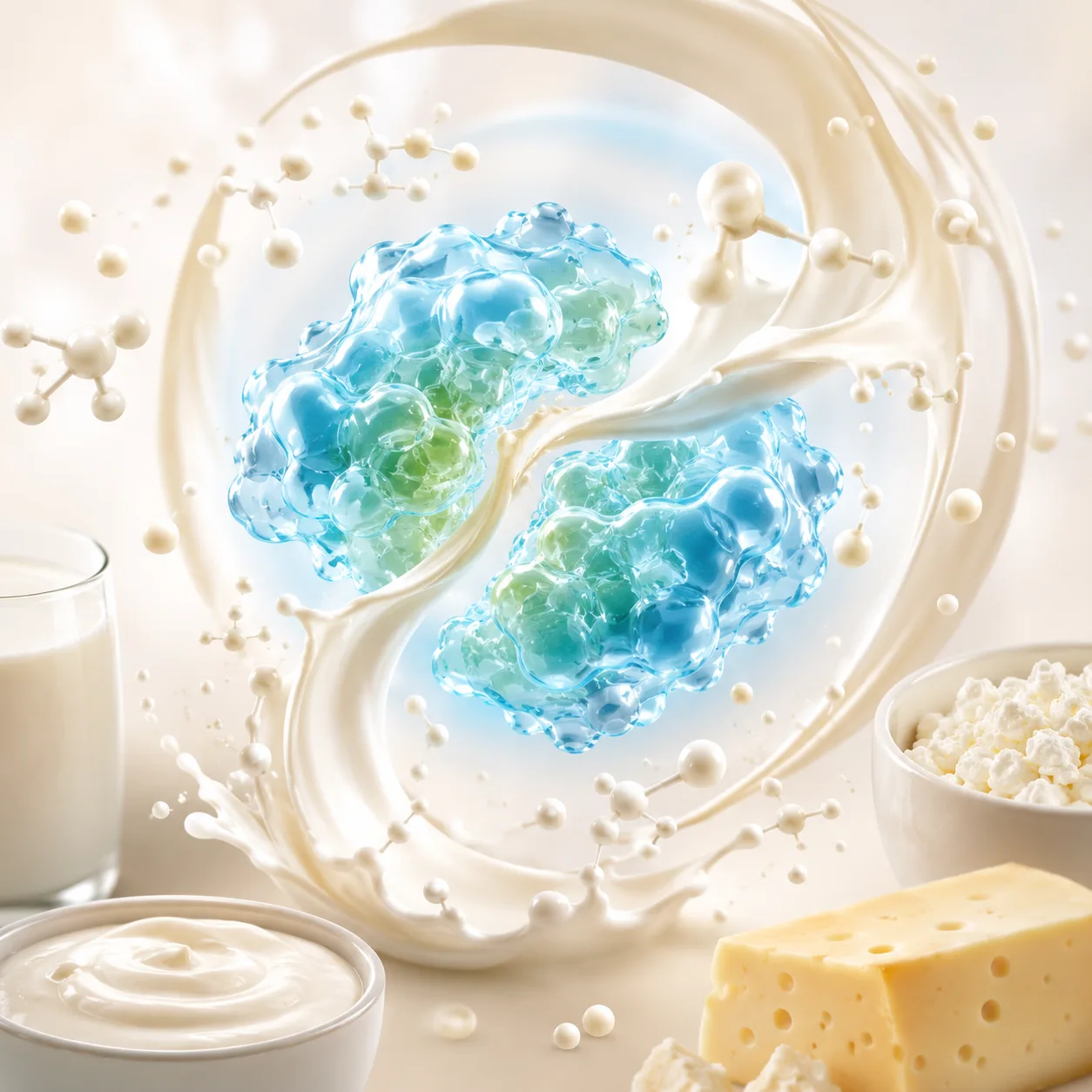
Lactase Catalytic Reaction Mechanism
Antozyme Lactase catalyzes the hydrolytic cleavage of complex glycosidic linkages in plant starches, hemicelluloses, and polysaccharide polymers. By breaking high-molecular-weight carbohydrate chains into uniform dextrins, maltose, and fermentable sugars, it achieves rapid viscosity reduction, improves filtration rates, and elevates downstream yield.
Cleavage Mode & Substrate Target
Endo- and exo-acting glycosidic hydrolase
Turnover Rate & Specific Velocity
Engineered for rapid catalytic saturation, maintaining high turnover velocity at low inclusion rates. This reduces batch cycle time by up to 40% across commercial bioreactors.
Zero Harmful Side-Reactions
Purified via precision ultrafiltration to remove undesirable secondary enzymatic activities, preventing bitter peptides, haze artifacts, or textile fiber degradation.
Technical Specifications & Analytical Parameters
Antozyme manufactures Lactase in both spray-dried micro-granule powder and stabilized liquid concentrate formats.
| Analytical Parameter | Certified Specification Standard | Compliance Monograph |
|---|---|---|
| Product Trade Name | AntoZyme Lactase Powder | Verified PASS |
| Product Class | Carbohydrases Enzyme System | Verified PASS |
| Production Strain | Selected Non-GMO SmF Microbial Culture | Verified PASS |
| Declared Activity | 100,000 U/g Declared Activity | Verified PASS |
| Optimum Temperature | 50°C – 95°C Process Optimum | Verified PASS |
| Optimum Operating pH | 4.5 – 6.5 Operating pH | Verified PASS |
| Physical Appearance | Off-white to light tan free-flowing micro-granule powder | Verified PASS |
| Carrier / Diluent | Food-grade maltodextrin / starch matrix | Verified PASS |
| Loss on Drying | ≤ 8.0% | Verified PASS |
| Heavy Metals (as Pb) | ≤ 10 ppm (Complies with FCC/USP) | Verified PASS |
| Total Plate Count | ≤ 10,000 CFU/g | Verified PASS |
| Salmonella & E. coli | Negative in 25g | Verified PASS |
| Standard Export Packaging | 25 kg fibre drums with double polyethylene liners | Verified PASS |
| Shelf Life & Storage | 24 months in sealed original packaging at 4°C – 25°C | Verified PASS |
Primary Industrial Application Areas & Dosing Guidelines
Select an industrial sector to inspect operating parameters, typical inclusion rates, and verified processing yield gains.
Yield Improvement & Process Acceleration
Enhances conversion efficiency, reduces processing bottlenecks, and stabilizes functional food properties across industrial bakeries, beverage extraction, and carbohydrate lines.
Enzyme Kinetics, Temperature Window & Stability
Industrial bioprocesses require precise catalytic control under varying plant conditions. Antozyme Lactase is formulated for consistent reaction kinetics across wide thermal and pH gradients.
Thermal Kinetics Window (50°C – 95°C Process Optimum)
Antozyme Lactase exhibits high catalytic efficiency across commercial operating temperatures (50°C to 95°C depending on formulation). In industrial mashing, saccharification, and processing lines, this stability prevents premature thermal denaturing and ensures maximum substrate turnover.
Operational pH Curve (4.5 – 6.5 Operating pH)
Optimized for standard industrial processing slurries between pH 4.2 and 6.8, maintaining high specific activity without requiring excessive chemical buffering or acid neutralization.
Cofactor Kinetics & Storage Stability
Activity is stabilized by trace divalent cations. Standard formulation ensures maximum shelf-life and thermal endurance under continuous commercial operating conditions.
Industrial Raw Material Compatibility & Specific Dosing Matrix
Recommended commercial inclusion rates across primary industrial substrates. Exact dosage varies based on dry solids concentration, retention time, and desired endpoint.
| Substrate Type | Solids % (DS) | Operating Temp | Recommended Dosing | Target Metric | Demonstrated Process Gain |
|---|---|---|---|---|---|
| Industrial Grain & Cereal Slurries | 25% – 32% DS | 55°C – 75°C | 0.2 – 0.5 kg / MT | Target Viscosity Collapse | Eliminates pipeline drag, speeds mash pumpability, and boosts batch throughput |
| Starch & Flour Hydrolysate Streams | 15% – 28% DS | 50°C – 65°C | 0.15 – 0.35 kg / MT | Controlled Hydrolysis | Consistent sugar spectrum, prevents retrogradation, and elevates filtration flux |
| Plant Protein & Seed Meals | 10% – 18% DS | 45°C – 60°C | 0.2% – 0.6% w/w | DH 10% – 18% | Increases protein solubility index, unlocks peptides, and minimizes bitter off-flavors |
| Commercial Brewing Malt Grist | Mash ratio 1:3.5 | 50°C – 68°C | 0.2 – 0.4 kg / MT grist | Optimal Wort Attenuation | Faster lautering run-off time, superior wort clarity, and increased brewhouse extract |
| Textile Fabric / Yarn Liquor | Liquor ratio 1:8 | 45°C – 60°C | 0.5 – 1.5 g/L bath | Complete Substrate Action | Zero fabric tensile loss, uniform dye uptake, and significant energy savings |
| Poultry & Aquafeed Premixes | Dry feed meal | Conditioning 75°C–85°C | 100 g / MT feed | Viscosity Breakdown | Improves gut health, reduces wet litter conditions, and boosts nutrient uptake |
Comparative Benchmark: Antozyme vs. Conventional Alternatives
Head-to-head performance comparison across seven critical commercial and operational parameters.
| Operational Metric | Antozyme Proprietary Formulation | Conventional Product | Chemical Reagent / Alternative |
|---|---|---|---|
| Manufacturing Platform | Modern Submerged Fermentation (SmF) | Solid-State Fermentation (SSF) | Chemical Reagents / Acids |
| Batch Specific Activity | High-Concentration Standardized Assays | Variable, unstandardized potencies | Non-catalytic stoichiometric consumption |
| Thermal Operating Range | Broad operational tolerance window | Narrow temperature plateau | Requires high thermal energy input |
| Byproduct & Impurity Profile | Zero harmful side-activities or toxins | Mixed secondary enzymes present | Generates toxic chemical salts & effluent |
| Effluent & Environmental Impact | 100% Biodegradable, zero salt burden | Moderate biological oxygen demand | High TDS, COD, and hazardous neutralizers |
| Water & Energy Savings | Saves 25% – 45% process energy & water | Baseline energy usage | High rinsing and neutralisation costs |
| Global Regulatory Accreditations | ISO 9001:2015, GMP, FSSAI, Halal Certified | Incomplete international certifications | Subject to chemical REACH/OSHA limits |
4-Stage Continuous Operating Plant SOP
Plant operating protocol designed for industrial shift supervisors, brewmasters, and chemical plant operators.
Substrate Preparation & Hydration
Pre-mix substrate slurry to target dry solids concentration. Adjust temperature and pH to optimum ranges (50°C – 95°C Process Optimum, 4.5 – 6.5 Operating pH) prior to enzyme introduction.
Enzyme Stock Pre-Dilution & Inoculation
Dilute measured Antozyme Lactase in 10x potable water. Disperse uniformly into the agitated processing tank to ensure rapid contact with substrate surfaces.
Calibrated Biocatalytic Reaction Hold
Maintain steady temperature and continuous circulation during the holding phase. Monitor substrate transformation via analytical sampling (viscosity, titration, or Brix).
Inactivation / Separation & Downstream Processing
Once the desired end-point is confirmed, thermally inactivate the enzyme by ramping to ≥ 85°C for 10 minutes, or proceed directly to downstream filtration.
Specimen Certificate of Analysis (COA)
Lot-specific analytical report demonstrating typical batch release testing and microbial clearance.
| Test Parameter | Analytical Test Method | Standard Release Limit | Actual Lot Result | Verification |
|---|---|---|---|---|
| Lactase Declared Activity | Standard Assay Monograph | ≥ Declared Activity | 103.5% of Label | PASS |
| Physical Appearance | Visual Inspection | Conforms to Specification | Conforms | PASS |
| Loss on Drying / Moisture | Karl Fischer / Gravimetric | ≤ 8.0% | 4.8% | PASS |
| Heavy Metals (as Pb) | ICP-MS Spectrometry | ≤ 10 ppm | < 1.5 ppm | PASS |
| Arsenic (As) | ICP-MS Spectrometry | ≤ 2 ppm | < 0.3 ppm | PASS |
| Total Aerobic Microbial Count | BAM / ISO 4833 | ≤ 10,000 CFU/g | 980 CFU/g | PASS |
| Coliforms & E. coli | BAM / ISO 4832 | Negative in 25g | Negative | PASS |
| Salmonella Species | ISO 6579 | Negative in 25g | Negative | PASS |
Packaging & Loading Configurations
Export packaging is designed to safeguard enzyme potency across international ocean freight lanes.
Double food-grade polyethylene inner heat-sealed liners with tamper-evident locking rings. Net: 25.0 kg | Tare: 1.8 kg.
Heavy-duty UN-rated high-density polyethylene containers with degassing caps to prevent pressure accumulation during sea transit.
Accommodates 800 fibre drums (20 Metric Tons net) palletized and shrink-wrapped with maritime container desiccants.
Global Port Transit Time Matrix
Fast ocean sailings routed from India's premier western ports: Nhava Sheva (JNPT) and Mundra Port.
| Destination Port | Origin Port | Sailing Transit | Service Frequency |
|---|---|---|---|
| Chittagong, Bangladesh | Nhava Sheva / Mundra | 5 – 7 Days | Bi-weekly Direct feeder |
| Jebel Ali, Dubai (UAE) | Mundra Port | 3 – 5 Days | 3 Sailings / Week |
| Ho Chi Minh City, Vietnam | Nhava Sheva | 10 – 14 Days | Weekly mainline service |
| Jakarta / Surabaya, Indonesia | Nhava Sheva | 12 – 15 Days | Weekly direct vessel |
| Mombasa, Kenya (East Africa) | Mundra Port | 10 – 12 Days | Weekly direct route |
| Santos, Brazil (Latin America) | Nhava Sheva | 28 – 35 Days | Fortnightly mainline |
| Rotterdam, Netherlands (Europe) | Mundra / Nhava Sheva | 20 – 24 Days | Weekly express direct |
Complementary Industrial Enzymes
Commonly paired in industrial formulation with Lactase to maximize biocatalytic efficiency:
Target Industry Solutions Hubs
Explore in-depth engineering guides for specific industrial processing verticals:
Frequently Asked Technical & Commercial Questions
Clear answers regarding Lactase dosing calibration, kinetics, shelf life, and international export logistics.
Request a Free 100g Lab Sample or Bulk Quote
All inquiries deliver directly to info@antozymebiotech.com and our export desk. Typical response time within 4 business hours.